

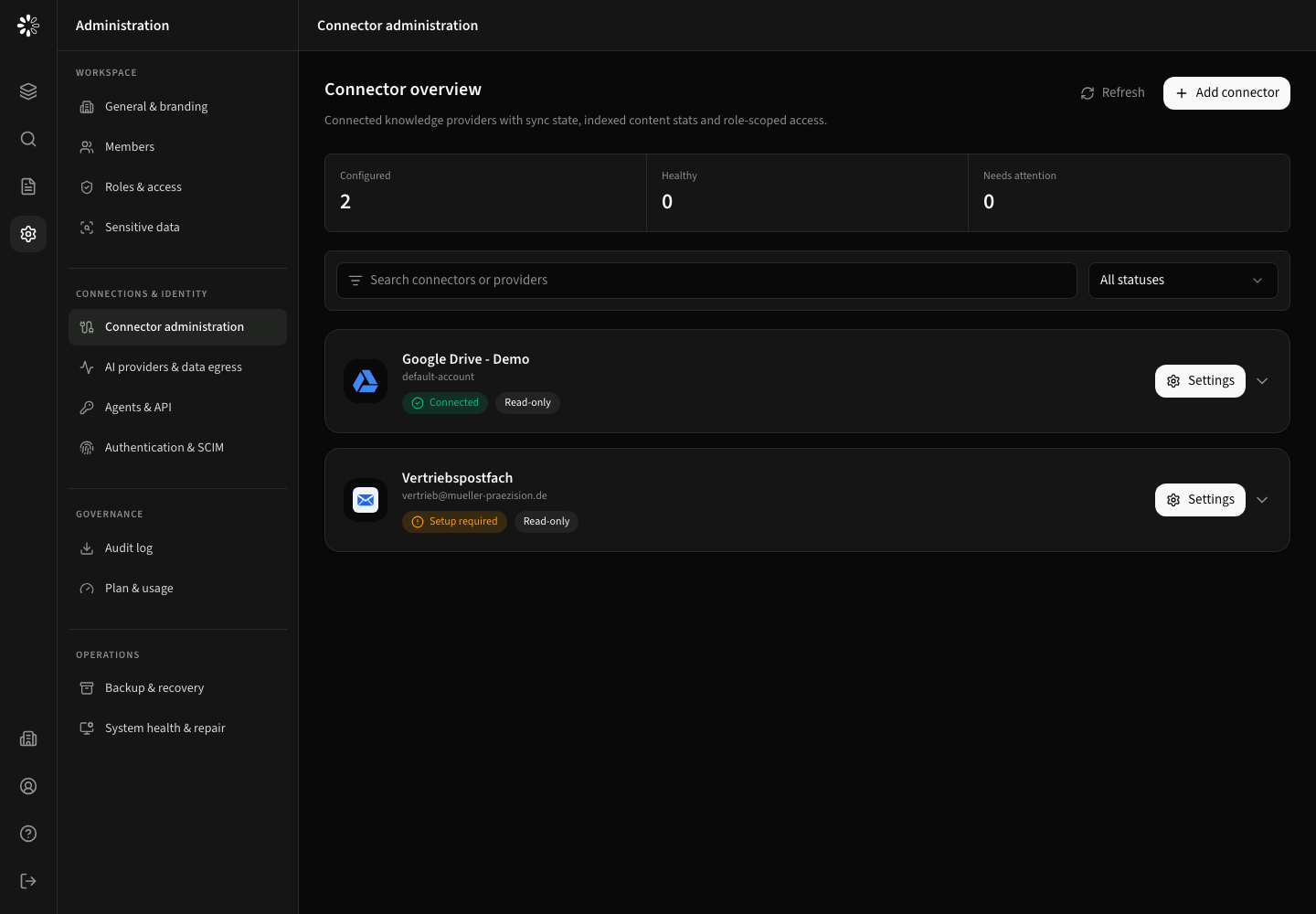
Connector overview
Understand provider types, connector instances, synchronization, and safe activation.
A provider describes an integration family such as Google Drive. A connector is one configured instance of that provider, such as Google Drive – Sales. You can add multiple instances of the same provider and give each a clear name.
Connector administration requires sources:manage and is located under Administration → Connections & identity → Connector administration.
Available provider families
| Provider | Connection | Typical change detection |
|---|---|---|
| Google Drive | Google OAuth 2.0 or service-account delegation | Drive Changes API or manual/full scan |
| SharePoint Online | Microsoft OAuth 2.0 through Microsoft Graph | Graph delta |
| Email / Exchange Online | Microsoft OAuth 2.0 through Microsoft Graph | Message delta per folder |
| Nextcloud | WebDAV username and app password | Scheduled WebDAV scan or webhook trigger |
| NAS | Filesystem path mounted into the CogLake environment | Scheduled or manual filesystem scan |
| SSH / SFTP | Username/password or SSH private key | Scheduled or manual remote scan |
The exact fields and strategies are supplied by the provider integration. Secrets are encrypted in storage and are not returned to the browser after saving.
The catalog shows only providers available to the current plan. Basic plans include the core connector set, while broader provider families and custom integrations require the matching plan capability. Plan availability is enforced by the API as well as the administration interface.
Connector cards
Cards start collapsed and show connection and sync status. Expand a card to inspect indexed files, folders, searchable sections, last sync, active scope, and available actions.
Start sync is intentionally explicit. Configure connection, scope, and role access before the first import so data is not indexed before the intended boundary is saved.