

Users, roles, and permissions
Manage identities and combine product permissions with workspace and connector access.
Users
Open Administration → Workspace → Members to invite a member, edit identity details, assign one or more roles, require a password change, disable access, or remove an account. Search and filter by status or role when the member list grows.
Invite a member
- Select Invite member and enter the person's email address and optional display name.
- Choose the platform role and any additional custom roles for this workspace.
- Send the invitation. The single-use link expires automatically.
- Use the pending invitations list to resend or revoke an invitation before it is accepted.
An existing CogLake identity keeps its current sign-in credentials and gains a separate membership in this workspace. A new identity chooses its name and password while accepting the invitation. Roles are stored per workspace, so the same person can be an administrator in one workspace and a member in another.
OIDC or SCIM-provisioned users can be associated with external email and group mappings. A stable internal user ID is used for access decisions; email remains identity and mapping information rather than the sole authorization key.
Platform role
Every custom role has a platform role of either Administrator or Member:
- Administrator is the trusted administrative baseline and receives the complete administrative permission set.
- Member starts without administrative authority and receives only the granular permissions you select.
Use Member for department, project, support, and read-only roles. Create as few platform-administrator roles as possible.
Product permissions
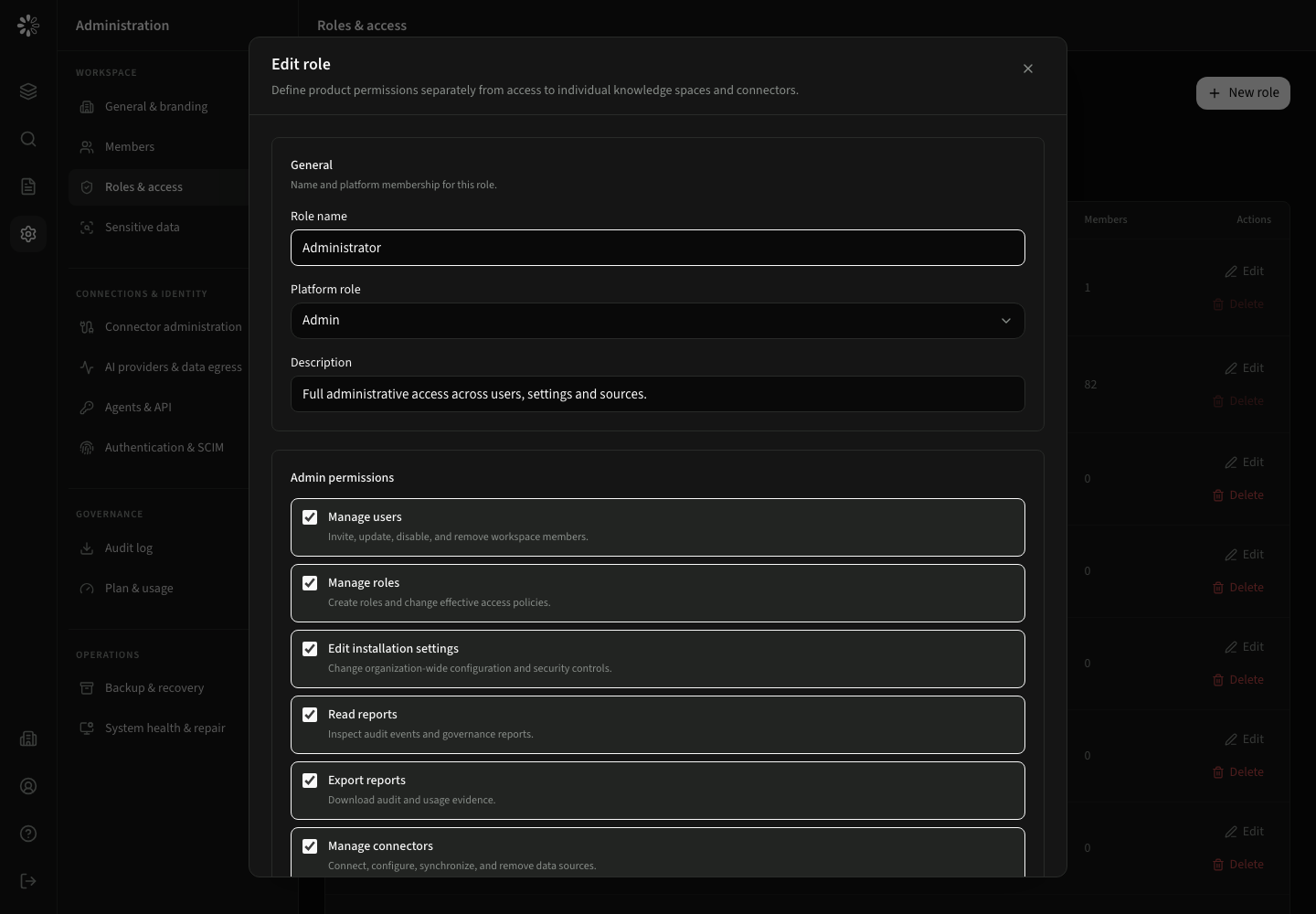
| Permission | Allows |
|---|---|
| Manage users | User lifecycle and identity mappings |
| Manage roles | Role policies and permission-preview searches |
| Edit installation settings | Authentication, appearance, backup, and repair operations |
| Read / export reports | Audit and operational reporting |
| Manage connectors | Connector setup, sync, diagnostics, and indexing operations |
| Read / write knowledge | Read or modify internal knowledge content |
| Create personal / company workspace | Create the respective workspace type |
| Use search and retrieval | Discover, answer, and retrieval requests |
Resource access
Product permissions are combined with resource scopes:
- Knowledge bases support None, Read, Write, and Admin.
- Connectors support None, Search, Read, and Write.
- A wildcard scope can apply to all matching resources; an explicit resource entry takes precedence.
The source ACL is checked after these scopes. For example, knowledge:read plus connector Read still does not reveal a Google Drive file that the connected source does not grant to the user's principals.
Built-in roles cannot be removed. A custom role must have no assigned members before it can be deleted; reassign affected members first.
Recommended setup
- Keep one small administrator role.
- Create business roles with platform role Member.
- Select only required product permissions.
- Add the exact workspaces and connectors each role needs.
- Use Discover's Preview search as role control to validate the result boundary.